
National Target Program for Climate Change in Vietnam: Transport & Energy
Client:
ADB through ICEM
Location:
Vietnam


Client:
ADB through ICEM
Location:
Vietnam
Vietnam’s National Target Program to Respond to Climate Change (NTPRCC), adopted in 2008, marked a critical step in addressing the country’s growing vulnerability to climate change. The program outlined national climate trends, sectoral and regional risks, and set priorities for legislation, planning, and investment, particularly during the 2009–2015 period. It also provided a framework for ministries and provinces to translate high-level climate objectives into sector-specific and regional action plans based on detailed impact assessments.
Within this context, the project focused on understanding how rapid urbanization and associated anthropogenic activities influence climate vulnerability, with particular emphasis on the transport and energy sectors under the mandates of the Ministry of Transport (MoT) and the Ministry of Industry and Trade (MoIT). While adaptation was the primary focus, mitigation considerations were also explored to support more climate-resilient urban development pathways.

The project delivered analytical and technical support to strengthen climate-responsive planning in the transport and energy sectors. Spatial Decisions contributed to reviewing national studies on urban development, climate change impacts, modelling scenarios, and sectoral response strategies. These inputs were synthesized to examine the links between urban growth patterns, infrastructure development, and climate risks.

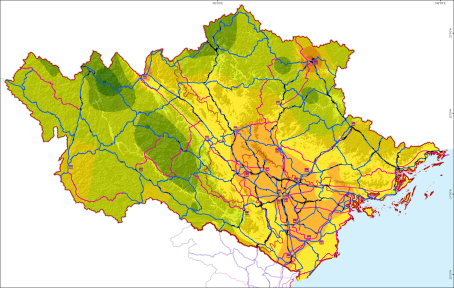
Geospatial analysis played a central role, with thematic mapping and spatial interpretation of climate change impacts on transport and energy infrastructure under nationally accepted climate scenarios. A national-level geospatial database was developed through close coordination with key government agencies and research institutes, including MoNRE (IMHEN), MoT (TDSI), and MoIT (IEE), ensuring data consistency and institutional ownership. The analysis also identified climate impact hotspots for 2030, 2050, and 2100, supporting evidence-based adaptation planning.
The project strengthened the evidence base for integrating climate change considerations into national transport and energy planning. By combining geospatial analysis with sectoral policy review, it enabled clearer identification of climate risk hotspots and infrastructure vulnerabilities under future climate scenarios. The outcomes supported more informed decision-making within line ministries, contributing to the development of targeted adaptation strategies and more resilient urban and infrastructure systems aligned with Vietnam’s national climate objectives.